A wolf trots through a hunter's shooting lane at 30 yards. A pack of 11 surrounds a deer stand near Clearwater County until nearly 8 p.m. A trail camera in Thief River Falls captures the same animals week after week. A wolf walks right up to a group of people in the woods — and barely flinches when they yell at it.
These aren't wildlife agency reports. They're eyewitness accounts from everyday Minnesotans — hunters, homeowners, hikers, and farmers — submitted to a community sighting map that has now collected over 1,000 reports spanning November 2023 through April 2026. Together, they paint one of the most detailed grassroots pictures of wolf presence in Minnesota ever assembled.
Here's what the data actually shows.
The sheer volume of trail camera evidence is striking. Wolves aren't just being glimpsed at the edge of a field — they're being documented repeatedly, at specific locations, by people who set cameras and check them regularly.
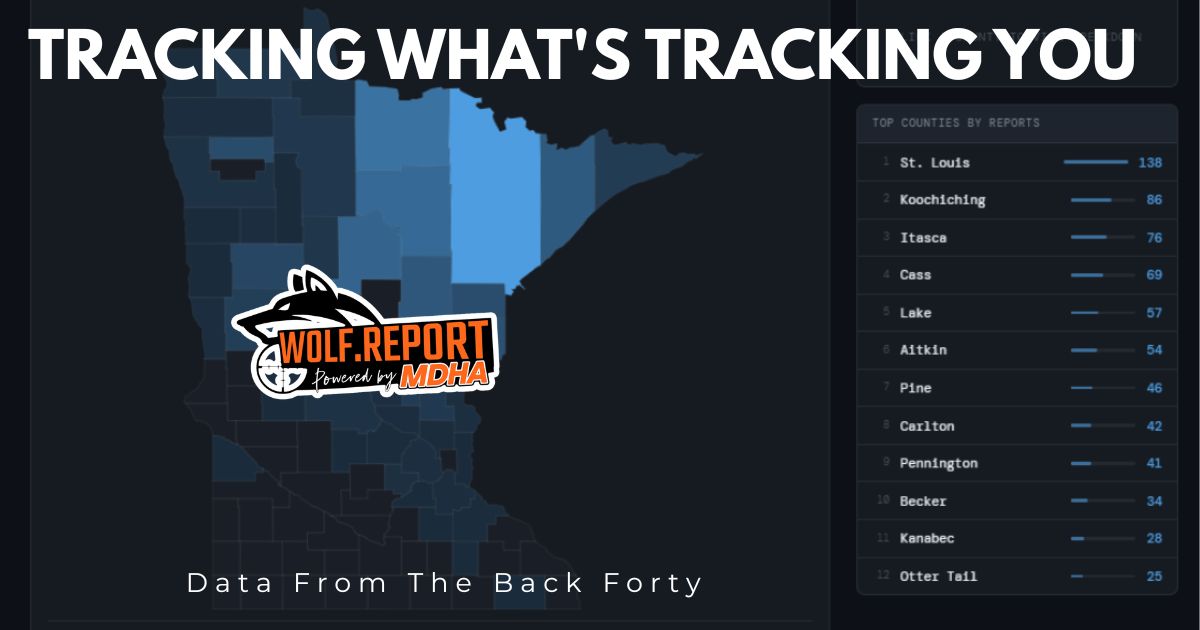
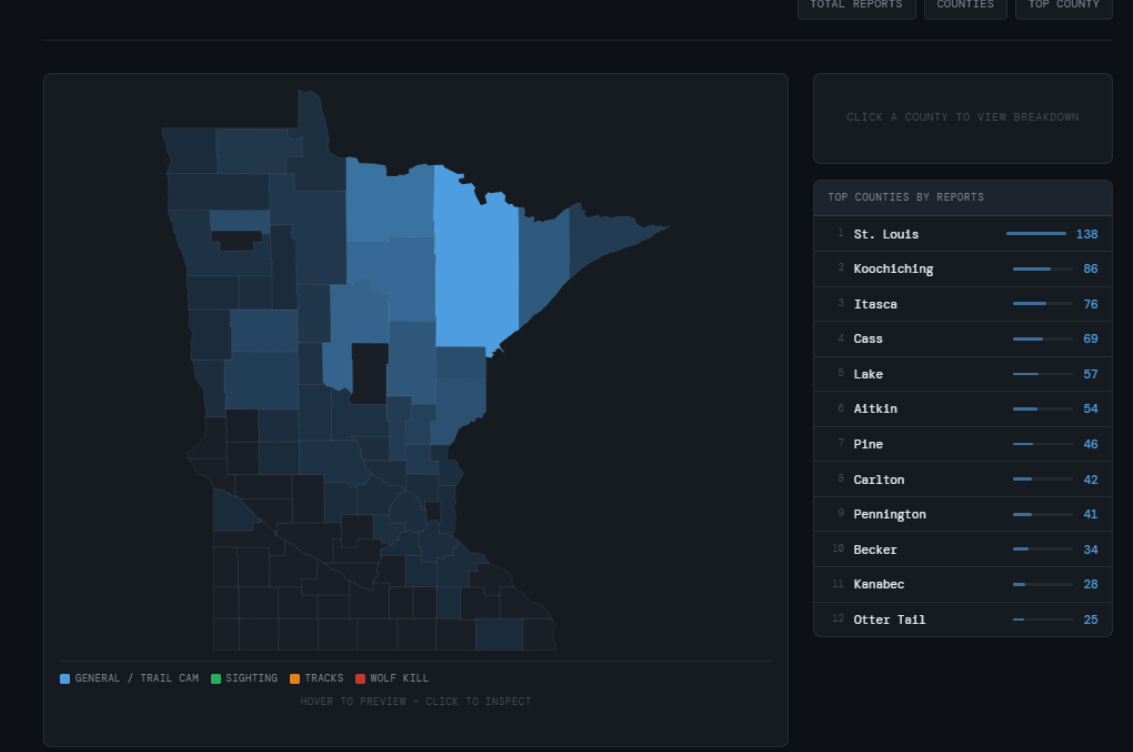
The geographic concentration is impossible to ignore. Wolf activity clusters overwhelmingly in northeastern and north-central Minnesota — the region wildlife managers have long recognized as core wolf habitat — but the data shows that presence is spreading well beyond traditional boundaries.
The top five counties by report volume:
| County | Reports | Notable |
|---|---|---|
| St. Louis | 138 | Covers Duluth, Ely, Iron Range |
| Koochiching | 86 | International Falls border region |
| Itasca | 76 | Grand Rapids area |
| Cass | 69 | Leech Lake, lake country |
| Lake | 57 | North Shore, Two Harbors |
St. Louis County alone accounts for nearly 14% of all reports — not surprising given its size, but also a reflection of dense activity across the Iron Range and BWCA-adjacent forests where wolves have thrived for decades.
What's more interesting is where wolves are showing up that they historically haven't. Pennington County (41 reports, centered on Thief River Falls) is a notable western hotspot. Kanabec, Pine, and Carlton counties in east-central Minnesota have meaningful numbers too. Reports have trickled in from Carver, Dakota, Hennepin, Chisago, and Isanti — counties that brush up against the Twin Cities metro area. VIEW INTERACTIVE MAP
The seasonal pattern in the data is unmistakable.
Reports by season:
Winter dominates for a few reasons. Fresh snow makes tracks visible and easy to photograph. Wolves follow deer into areas near human activity — logging roads, hunting cabins, agricultural edges — as natural prey concentrates. And hunters are in the field, cameras are active, and people are paying attention.
December 2023 was the single busiest month in the entire dataset with 164 reports — a remarkable spike that coincided with the opening of deer season and early winter snowfall across northern Minnesota. March 2024 followed closely with 121 reports, driven by late-winter activity and tracks still visible in snow.
Summer activity nearly disappears. Wolves den in late spring, pups stay close to home through summer, and the thick vegetation makes encounters far less likely. The 44 summer reports represent a real baseline of year-round presence rather than seasonal surge.
The data shows a meaningful ramp-up from the project's launch:
Annualizing the partial years, 2024 was the peak, with 2025 coming in somewhat lower. It's worth noting this is community-reported data, so increases may reflect growing awareness of the reporting tool as much as — or alongside — changes in actual wolf activity. Still, the sustained volume across multiple years suggests this isn't a fleeting trend.
Some of the most compelling entries involve pack sightings — multiple wolves moving together, often in close proximity to people.
A hunter near Clearwater County wrote that 11 wolves surrounded his stand and kept him pinned there until 7:45 p.m., adding: "They weren't even scared of me."
Another report from the Itasca area described a pack of 8–10 wolves running through while a hunter sat in a deer stand. Near Fish Lake Reservoir, someone watched 8–9 wolves crossing the ice, including one fully black wolf at the rear of the group.
A ground blind hunter had 9 wolves walk past at 30 yards on a Saturday morning deer hunt.
These aren't fleeting glimpses — these are extended encounters with organized groups. Pack behavior in the data suggests territories that overlap significantly with active hunting and recreation areas.
One of the more unsettling themes running through the reports is wolves that show little or no fear of humans.
From Floodwood: "The wolf was strolling in our backyard. Our dog or child could have easily been in our backyard playing."
From a forest road encounter: "This wolf basically walked right up to us. We had to roll down the windows and yell at it. It eventually walked slowly away from us."
From a rural driveway near Isle: "Wolf in driveway."
From Embarrass, on a Sunday morning: "Deer ran across the road in front of me, followed by a wolf chasing it" — in broad daylight, in a residential area.
Habituation to human presence is a well-documented phenomenon in wolf populations that have been protected for extended periods. Whether this represents a behavioral shift in Minnesota wolves broadly, or clusters of particularly bold individuals, is a question the data alone can't answer — but the pattern across dozens of reports is hard to dismiss.
The 16 confirmed wolf kill reports represent only the incidents that were documented and submitted. The actual toll on livestock and deer is almost certainly higher.
Reports reference deer carcasses being dragged, deer kills found near cabins, and wolves feeding on dead livestock. One entry from near Grand Rapids clarified: "Not a wolf kill. These wolves were feeding on some dead livestock on our property" — suggesting even the submitter felt compelled to distinguish between opportunistic scavenging and active predation.
For cattle and livestock producers on the fringes of wolf range — particularly in areas like Otter Tail, Morrison, and Todd counties — the encroachment documented in this data is not abstract. It's a fence line away.
Two-thirds of all reports in this dataset come from trail cameras. That's not just a reflection of how people spend time outdoors in Minnesota — it's a testament to how dramatically remote camera technology has changed our understanding of wildlife.
A wolf on a salt block in Askov. A pack moving through the woods near Bigfork captured on video. Repeated visits to the same logging road near Tamarack documented across three separate entries in a single month.
Trail cameras don't lie, don't exaggerate, and don't need to be in the right place at the right time. They simply wait. And what they're capturing, season after season, is a consistent, widespread wolf presence that extends well beyond what any single agency survey could document.
Community-reported data has real limitations worth acknowledging. The same animal may be reported multiple times by different people. Reports cluster where people are, not necessarily where wolves are — so areas with fewer hunters and fewer cabins are likely undercounted. The absence of a report doesn't mean the absence of wolves.
This data also can't tell us population numbers, pack territories with precision, or whether trends reflect actual wolf population changes or changes in reporting behavior. What it can tell us is that wolves are present, active, and increasingly documented across a wider swath of Minnesota than many people realize.
Minnesota has the largest gray wolf population in the lower 48 states — estimated at roughly 2,600–3,000 animals in recent surveys. They've been a flashpoint in debates over federal endangered species protections, state management authority, and hunting season proposals for years.
What this community dataset adds to that debate is texture. Not statistics from aerial surveys or GPS collar data, but the lived experience of people sharing landscapes with wolves — hunters who watch packs move through their stands, homeowners whose dogs bark at something on the tree line, farmers whose livestock don't come home.
Over 1,000 of those experiences, mapped and timestamped, tell a story that's worth paying attention to: wolves in Minnesota are not a distant wilderness concern. For a growing number of communities across the northern half of the state, they're a neighbor.